57. Ring Based Poll Mode Driver
The ring-based PMD (librte_net_ring) allows software FIFOs (rte_ring)
to be accessed using the PMD API, as though they were physical NICs.
57.1. Using the Driver from the EAL Command Line
DPDK allows pseudo-Ethernet devices, as the ring driver, to be created at application startup time during EAL initialization.
To do so, pass the --vdev=net_ring0 parameter to the EAL.
This parameter accepts options to allocate and use ring-based Ethernet
transparently by the application.
This can be used, for example, for testing on a virtual machine
where there are no Ethernet ports.
The device names passed to the --vdev option must start with net_ring
and take no additional parameters.
Multiple devices may be specified using multiple --vdev arguments.
./dpdk-testpmd -l 1-3 --vdev=net_ring0 --vdev=net_ring1 -- -i
...
Interactive-mode selected
Configuring Port 0 (socket 0)
Configuring Port 1 (socket 0)
Checking link statuses...
Port 0 Link Up - speed 10000 Mbps - full-duplex
Port 1 Link Up - speed 10000 Mbps - full-duplex
Done

testpmd> start tx_first
io packet forwarding - CRC stripping disabled - packets/burst=16
nb forwarding cores=1 - nb forwarding ports=2
RX queues=1 - RX desc=128 - RX free threshold=0
RX threshold registers: pthresh=8 hthresh=8 wthresh=4
TX queues=1 - TX desc=512 - TX free threshold=0
TX threshold registers: pthresh=36 hthresh=0 wthresh=0
TX RS bit threshold=0 - TXQ flags=0x0

testpmd> stop
Telling cores to stop...
Waiting for lcores to finish...
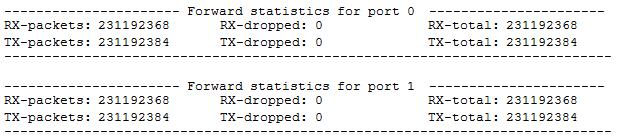
+++++++++++++++ Accumulated forward statistics for allports++++++++++
RX-packets: 462384736  RX-dropped: 0 RX-total: 462384736
TX-packets: 462384768  TX-dropped: 0 TX-total: 462384768
+++++++++++++++++++++++++++++++++++++++++++++++++++++

Done.
57.2. Using the Ring-based PMD from an Application
The driver provides an API to create PMD (rte_ethdev structure) instances
at run-time in the end-application using the function rte_eth_from_rings().
This functionality can be used to allow data exchange between cores using rings
in the same way as sending or receiving packets from an Ethernet device.
57.2.1. Usage Examples
To create two pseudo-Ethernet ports where all traffic sent to a port is looped back for reception on the same port (error handling omitted for clarity):
#define RING_SIZE 256
#define NUM_RINGS 2
#define SOCKET0 0

struct rte_ring *ring[NUM_RINGS];
int port0, port1;

ring[0] = rte_ring_create("R0", RING_SIZE, SOCKET0, RING_F_SP_ENQ|RING_F_SC_DEQ);
ring[1] = rte_ring_create("R1", RING_SIZE, SOCKET0, RING_F_SP_ENQ|RING_F_SC_DEQ);

/* create two ethdev's */
port0 = rte_eth_from_rings("net_ring0", ring, NUM_RINGS, ring, NUM_RINGS, SOCKET0);
port1 = rte_eth_from_rings("net_ring1", ring, NUM_RINGS, ring, NUM_RINGS, SOCKET0);
To create two pseudo-Ethernet ports where the traffic is switched between them (traffic sent to port 0 is read back from port 1 and vice-versa), the final two lines can be changed as follows:
port0 = rte_eth_from_rings("net_ring0", &ring[0], 1, &ring[1], 1, SOCKET0);
port1 = rte_eth_from_rings("net_ring1", &ring[1], 1, &ring[0], 1, SOCKET0);
This type of configuration is useful in a pipeline model where inter-core communication using pseudo Ethernet devices is preferred over raw rings for API consistency.
Enqueuing and dequeuing items from an rte_ring
using the ring-based PMD may be slower than using the native ring API.
DPDK Ethernet drivers use function pointers
to call the appropriate enqueue or dequeue functions,
while the rte_ring specific functions are direct function calls
and are often inlined by the compiler.
Once an ethdev has been created for a ring-based PMD,
it should be configured and started in the same way as a regular Ethernet device:
call rte_eth_dev_configure() to set the number of receive and transmit queues,
then call rte_eth_rx_queue_setup() / tx_queue_setup() for each of those queues,
and finally call rte_eth_dev_start() to allow transmission and reception of packets to begin.