3. ABI Policy
3.1. Description
This document details the management policy for ensuring long-term stability of the DPDK ABI and API.
3.2. General Guidelines
Major ABI versions are declared no more frequently than yearly. Compatibility with the major ABI version is mandatory in subsequent releases until a new major ABI version is declared.
Major ABI versions usually, but not always, align with a LTS release.
DPDK manages the ABI version at a project level, reflecting it in all non-experimental library sonames.
Preserve the ABI and avoid changing it lightly. ABI changes must follow the outlined deprecation process.
Adding symbols is generally not problematic. Manage modification of symbols with ABI Versioning.
Removing symbols is considered an ABI breakage; once approved, these removals form part of the next ABI version.
Libraries or APIs marked as experimental may be changed or removed without prior notice, as they are not considered part of an ABI version. The experimental status of an API is not an indefinite state.
Treat updates to the minimum hardware requirements, which drop support for previously supported hardware, as an ABI change.
Note
This policy does not currently apply to the Windows build.
3.2.1. What is an ABI?
An ABI (Application Binary Interface) is the set of runtime interfaces exposed by a library. It is similar to an API (Application Programming Interface) but is the result of compilation. Applications effectively clone the ABI when+linking to dynamic libraries. When an application compiles and links against dynamic libraries, the ABI must remain constant between compile/link time and runtime. Therefore, in the case of dynamic linking, it is critical to preserve the ABI, or (when modifying it) to do so in a way that prevents the application from behaving improperly or unexpectedly.
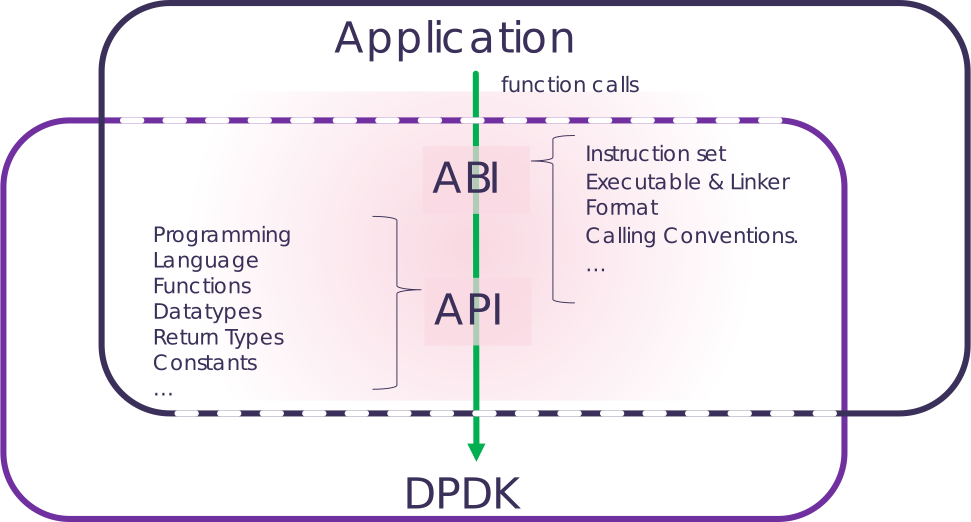
Fig. 3.22 Illustration of DPDK API and ABI.
3.2.2. What is an ABI version?
An ABI version is an instance of a library’s ABI at a specific release. Certain releases are considered milestone releases, the yearly LTS release for example. The ABI of a milestone release may be declared as a ‘major ABI version’, where this ABI version is then supported for some number of subsequent releases and is annotated in the library’s soname.
ABI version support in subsequent releases facilitates application upgrades by enabling applications built against the milestone release to upgrade to subsequent releases of a library without a rebuild.
More details on major ABI version can be found in the ABI versioning guide.
3.3. The DPDK ABI policy
A new major ABI version is declared no more frequently than yearly, with declarations usually aligning with an LTS release, e.g., ABI 21 for DPDK 20.11. Compatibility with the major ABI version is then mandatory in subsequent releases until the next major ABI version is declared, e.g., ABI 22 for DPDK 21.11.
At the declaration of a major ABI version, major version numbers encoded in
libraries’ sonames are bumped to indicate the new version, with the minor
version reset to 0. For example, librte_eal.so.21.3 becomes
librte_eal.so.22.0.
The ABI may then change multiple times, without warning, between the last major ABI version increment and the HEAD label of the git tree, with the condition that ABI compatibility with the major ABI version is preserved and therefore sonames do not change.
Minor versions are incremented to indicate the release of a new ABI compatible
DPDK release, typically the DPDK quarterly releases.
For example, librte_eal.so.21.1 indicates the first ABI compatible DPDK release
following the declaration of the new major ABI version 21.
An ABI version is supported in all new releases until the next major ABI version is declared. When changing the major ABI version, the release notes detail all ABI changes.
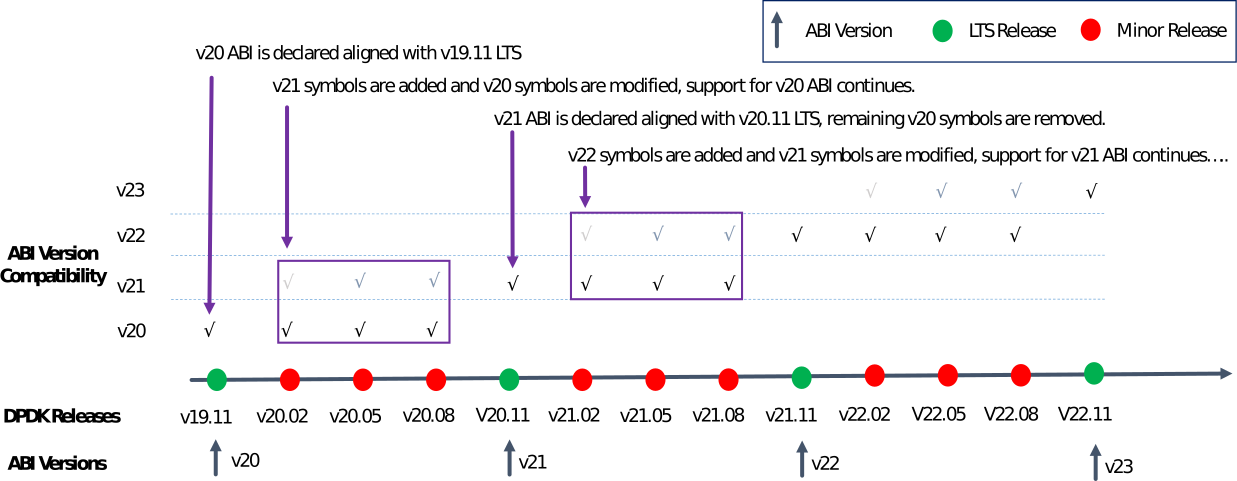
Fig. 3.23 Mapping of new ABI versions and ABI version compatibility to DPDK releases.
3.3.1. ABI Changes
The ABI may still change after declaring a major ABI version — new APIs may be added or existing APIs modified.
Warning
This policy details the method by which the ABI may be changed, with due regard to preserving compatibility and observing deprecation notices. However, do not undertake this process lightly; as a general rule, ABI stability is extremely important for downstream consumers of DPDK. Change the API only for significant reasons, such as performance enhancements. Avoid API breakages due to changes such as reorganizing public structure fields for aesthetic or readability purposes.
The requirements for changing the ABI are:
At least 3 acknowledgments of the need to do so must be made on the dpdk.org mailing list.
The component maintainer must acknowledge the change, or if no maintainer is available for the component, the tree/sub-tree maintainer for that component must acknowledge the ABI change instead.
Three members of the technical board, as delegates of the technical board, must also acknowledge the need for the ABI change.
Seek acknowledgments from different “areas of interest” for each deprecation, for example: from NIC vendors, CPU vendors, end-users, etc.
Maintain backward compatibility with the major ABI version through ABI Versioning, with forward-only compatibility offered for any ABI changes that are indicated to be part of the next ABI version.
In situations where backward compatibility is not possible, read the section on ABI Breakages.
No backward or forward compatibility is offered for API changes marked as
experimental, as described in the section on Experimental APIs and Libraries.In situations in which an
experimentalsymbol has been stable for some time, when promoting the symbol to become part of the next ABI version, the maintainer may choose to provide an alias to theexperimentaltag, so as not to break consuming applications.
If a newly proposed API functionally replaces an existing one, when the new API becomes non-experimental, then the old one is marked with
__rte_deprecated.The deprecated API should follow the notification process to be removed; see Examples of Deprecation Notices.
At the declaration of the next major ABI version, those ABI changes then become a formal part of the new ABI and the requirement to preserve ABI compatibility with the last major ABI version is dropped.
The original contributor of the ABI changes is responsible for removing redundant ABI compatibility code; failing that, the contributor’s company, and then finally the maintainer.
Note
Forward-only compatibility is offered for changes made between major ABI versions. As a library’s soname can only describe compatibility with the last major ABI version, until the next major ABI version is declared, these changes cannot be resolved as a runtime dependency through the soname. Therefore, any application wishing to use these ABI changes can only ensure that its runtime dependencies are met through Operating System package versioning.
Note
Treat updates to the minimum hardware requirements, which drop support for previously supported hardware, as an ABI change, and follow the relevant deprecation policy procedures as above: 3 acks, technical board approval, and announcement at least one release in advance.
3.3.2. ABI Breakages
An amended process exists for ABI changes too significant to reasonably maintain multiple symbol versions. In these cases, ABIs may be updated without providing backward compatibility. These changes must follow the same process described above as non-breaking changes, with the following additional requirements:
ABI breaking changes (including an alternative map file) can be included with the deprecation notice, wrapped by the
RTE_NEXT_ABIoption, to provide more details about upcoming changes. TheRTE_NEXT_ABIwrapper is removed at the declaration of the next major ABI version.Once approved, and after the deprecation notice has been observed, these changes form part of the next declared major ABI version.
3.3.3. Examples of ABI Changes
The following are examples of allowable ABI changes occurring between declarations of major ABI versions.
DPDK 20.11 release defines the function
rte_foo();rte_foo()is part of the major ABI version21.DPDK 21.02 release defines a new function
rte_foo(uint8_t bar). This is not a problem as long as the symbolrte_foo@DPDK_21is preserved through ABI Versioning.The new function may be marked with the
__rte_experimentaltag for a number of releases, as described in the section Experimental.Once
rte_foo(uint8_t bar)becomes non-experimental,rte_foo()is declared as__rte_deprecatedand a deprecation notice is provided.
DPDK 20.11 is not re-released to include
rte_foo(uint8_t bar); the new version ofrte_fooonly exists from DPDK 21.02 onwards as described in the note on forward-only compatibility.DPDK 21.02 release defines the experimental function
__rte_experimental
rte_baz()
. This function may or may not exist in the DPDK 21.05 release.An application
dPacketwishes to userte_foo(uint8_t bar)before the declaration of the DPDK22major ABI version. The application can only ensure its runtime dependencies are met by specifyingDPDK (>= 21.2)as an explicit package dependency, as the soname can only indicate the supported major ABI version.At the release of DPDK 21.11, the function
rte_foo(uint8_t bar)becomes formally part of the new major ABI version DPDK22andrte_foo()may be removed.
3.3.4. Examples of Deprecation Notices
The following are some examples of ABI deprecation notices to add to the Release Notes:
The Macro
#RTE_FOOis deprecated and will be removed with ABI version 22, to be replaced with the inline functionrte_foo().The function
rte_mbuf_grok()has been updated to include a new parameter in version 21.2. Backward compatibility will be maintained for this function until the release of the new DPDK major ABI version 22, in DPDK version 21.11.The members of
struct rte_foohave been reorganized in DPDK 21.02 for performance reasons. Existing binary applications will have backward compatibility in release 21.02, while newly built binaries will need to reference the new structure variantstruct rte_foo2. Compatibility will be removed in release 21.11, and all applications will require updating and rebuilding to the new structure at that time, which will be renamed to the originalstruct rte_foo.Significant ABI changes are planned for the
librte_dostufflibrary. The upcoming release 21.02 will not contain these changes, but release 21.11 will, and no backward compatibility is planned due to the extensive nature of these changes. Binaries using this library built prior to ABI version 22 will require updating and recompilation.
3.4. New ABI versions
A new ABI version may be declared aligned with a given release. The requirement to preserve compatibility with the previous major ABI version is then dropped for the duration of this release cycle. This is commonly known as the ABI breakage window, and some amended rules apply during this cycle:
The requirement to preserve compatibility with the previous major ABI version, as described in the section ABI Changes, does not apply.
Contributors of compatibility preserving code in previous releases are now required to remove this compatibility code, as described in the section ABI Changes.
Update symbol versioning references to the old ABI version to reference the new ABI version, as described in the section Deprecating an entire ABI version.
Contributors of aliases to experimental in previous releases, as described in section Aliasing experimental symbols, are now required to remove these aliases.
Finally, the ABI breakage window is not permission to circumvent the other aspects of the procedures to make ABI changes described in ABI Changes; that is, 3 ACKs of the requirement to break the ABI and the observance of a deprecation notice are still mandatory.
3.5. Experimental
3.5.1. APIs
APIs marked as experimental are not considered part of an ABI version and
may be changed or removed without prior notice. Since changes to APIs are most likely
immediately after their introduction, as users begin to take advantage of those
new APIs and start finding issues with them, new DPDK APIs are automatically
marked as experimental to allow for a period of stabilization before they
become part of a tracked ABI version.
Note that marking an API as experimental is a multi-step process. To mark an API as experimental, annotate the symbols to be exported with a RTE_EXPORT_EXPERIMENTAL_SYMBOL call in the corresponding libraries’ sources. Comment experimental symbols so that it is clear in which DPDK version they were introduced.
Secondly, mark the corresponding prototypes of those exported functions (in the
development header files) with the __rte_experimental tag
(see rte_compat.h).
In addition to tagging the code with __rte_experimental,
the doxygen markup must also contain the EXPERIMENTAL string,
and the MAINTAINERS file should note the EXPERIMENTAL libraries.
For removing the experimental tag associated with an API, a deprecation notice is not required. However, an API should remain in experimental state for at least one release. Thereafter, the normal process of posting a patch for review to the mailing list can be followed.
After formally removing the experimental tag, a tree/sub-tree maintainer may choose to offer an alias to the experimental tag so as not to break applications using the symbol. The alias is then dropped at the declaration of next major ABI version.
3.5.2. Libraries
Libraries marked as experimental are entirely not considered part of an ABI
version.
All functions in such libraries may be changed or removed without prior notice.
3.5.3. Promotion to stable
Review an API’s experimental status annually,
by both the maintainer and/or the original contributor.
Ordinarily, promote APIs marked as experimental to the stable ABI
once a maintainer is satisfied that the API is mature
and is unlikely to change.
In exceptional circumstances, should an API still be classified
as experimental after two years
and be without any prospect of becoming part of the stable API,
the API will then become a candidate for removal,
to avoid the accumulation of abandoned symbols.
Should an ABI change, usually due to a direct change to the API’s signature, it is reasonable for the review and expiry clocks to reset. The promotion or removal of symbols will typically form part of a conversation between the maintainer and the original contributor.